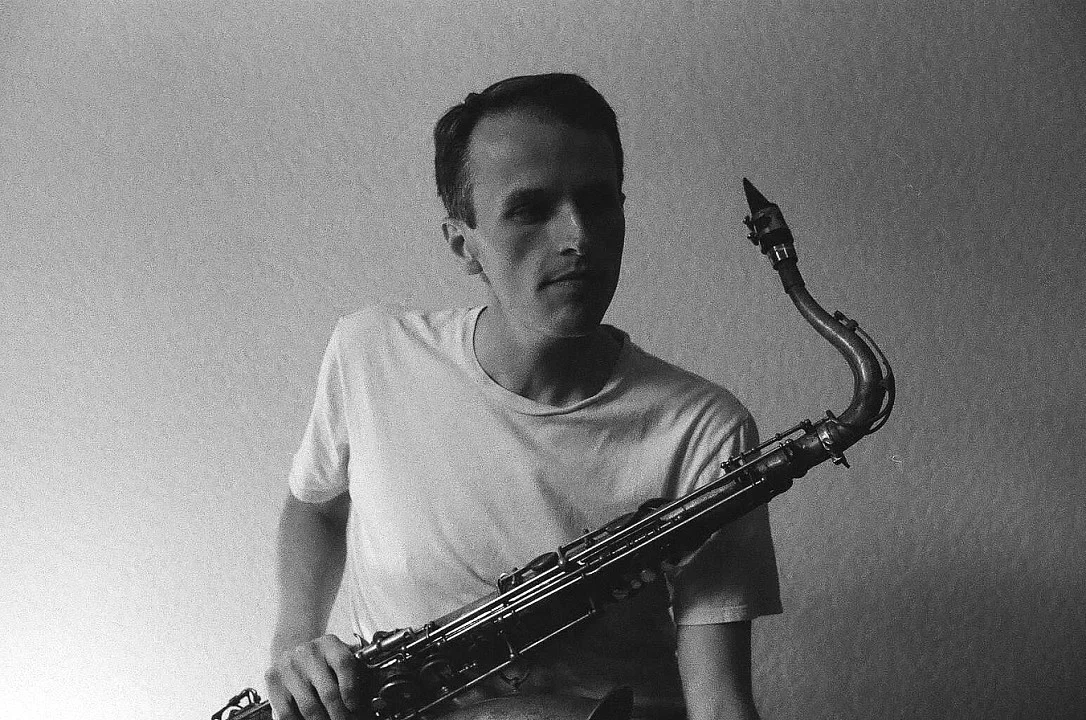
neil welch....{{{12moons}}}

05/23/2013 (12 Moons Solo Practice)

12 Moons Solo Saxophone Project Day 143

Date: 05/23/2013

Instrument: Alto saxophone

Location: Practice room B at South Whidbey High School.  Langley, WA (Whidbey Island)

Notes:

Today I worked with non-tempered pitches that had a siren-like call to them, surrounded by undulating tones that were muted and presented at a steady pace beneath.  There were two siren calls, the first being in the upper register with very bright and present tones, and the second being in the upper-mid register with more of a subdued quality.  I thought of this improvisation as occupying two words, the first being the siren pitches and the second being the lower tones.  I attempted to keep the lower world, with it’s twisting, cyclic sounds coursing nearly at all times, whereas the upper siren-calls would only step into the forefront occasionally.  

There was a single fingering used during this improvisation, with side keys added or taken away to create the cycles.  The siren call in the upper register used the follow fingering:

(Left Hand) B-A-G keys, Octave, Low Bb // (Right Hand) E-D keys.  Flick open and closed the Low C to allow the pitch to pop out at a high level of volume.  This create the notes (in the alto key) of High C, and High D (quarter step sharp).

The siren call in the upper-mid register used the same fingering, but had the Low C held completely down.  The undulating lower register tones used primarily the low F# and A, and were made with the above finger creating a cycle by opening and closing the Palm Eb and Side C one at a time in repetition.

-Neil

The image “‘61 Pontiac” accompanying today’s post by Robert Bechtle (1968-69)


05/22/2013 (12 Moons Solo Project Day 142)

12 Moons Solo Saxophone Project Day 142

Date: 05/22/2013

Instrument: Tenor saxophone

Location: Home studio in Clinton, WA (Whidbey Island)

Notes:

This afternoon I worked with fixed scales that had a bluesy quality to them.  Eventually I began  transitioning the use of tempered pitches to more pliable ones with false fingerings.  My improvisation today use a fixed scale with six different findings.  This created a 7 note scale with non-tempered, de-tuned pitches.  Some of the fingerings used make it possible to play a minor third, or minor second simultaneously. For example, with the pitches Bb and B the melodic variation between the notes was achieved with movement in air flow and embouchure with a single fingering.  

The fingerings (from lowest to highest and in the tenor key)

1.  C# (slightly sharp) (Left Hand) B-A-G keys, Octave, Low Bb, Palm Eb // (Right Hand) F-E keys, Side F#, Low C. 

2.  D (quarter step sharp) (Left Hand) B-A-G keys, Octave, Low Bb, Palm Eb // (Right Hand) F-E keys, Low C.  

3. F (quarter step sharp) (Left Hand) B-A-G keys, Octave, Low Bb // (Right Hand) F-E keys, Low C.  There is also naturally a minor third F to D chord with this fingering that speaks at times.  

4.  F# (quarter step sharp) (Left Hand) B-A-G keys, Octave, Low Bb // (Right Hand) F-E keys, Side F#, Low C.

5-6. Bb and B (Left Hand) B key, Octave, Low Bb // (Right Hand) F-E-D keys, Low Eb.  To achieve each pitch bend with embouchure.

7.  C# (Left Hand) B key, Octave, Low Bb // (Right Hand) F-E-D keys, Low Eb.

-Neil

The image accompanying today’s post is of Chinese artist and activist Ai Weiwei, who released a new music video today.


05/21/2013 (12 Moons Solo Project Day 141)

12 Moons Solo Saxophone Project Day 141

Date: 05/21/2013

Instrument: Tenor saxophone

Location: Small Theatre at Chief Sealth International High School.  Seattle, WA

Notes:

The physical landscape outside looked like a perfect grey scale today, and the radio was filled with harrowing stories from survivors of the devastating Tornado in Oklahoma.  This improvisation is dedicated to those folks now recovering.  This sound exploration surveyed a mood of melancholy that I carried with me through most of the day.  I seemed to feel every physical motion and mental experience very personally today and with an unusual amount of sensitivity of thought.  In my improvisation I tried to capture this depth of mood as best I could, exploring brooding melodic figures mixed with the constancy of a continuous, slow trill in the lower end of the instrument.  

This is an unusual melodic and harmonic action, in that the continuous whole-step melodic figure in the low end was achieved but pressing and releasing the octave key.  This created a muted figure that was only audible at a low volume.  At the same time, the fingering produced quiet bends in the upper register from a Concert Eb to an E.  This forced me to split my mind completely, focusing simultaneously on maintaining an even tempo in the slow trill, and bending, warping and sliding melodic figures in the upper register.  It truly was a marriage of two completely different trains of the thought.

The fingering was as follows:

(Left Hand) Fork F, A keys, Low Bb // (Right Hand) F-E keys, Low C.  To create the trill, open and close the register key with the thumb.  The melodic shapes above are achieved with the embouchure.  Other rhythmic and melodic cycles were made by opening and closing the side Bb, C and High F keys while also trilling the B key in the left hand.

-Neil

The image “White Painting” by Albert Kotin (1950’s).


05/20/2013 (12 Moons Solo Project Day 140)

12 Moons Solo Saxophone Project Day 140

Date: 05/20/2013

Instrument: Tenor saxophone

Location: Home studio in Clinton, WA (Whidbey Island)

Notes:

The use of double-tonging was a focus during my practice time this afternoon.  I’m still a relative novice at the use of this technique as I’ve really only delved deeply into it for about two or three years.  I’m currently surveying my ability to use the technique within specific ranges of the instrument, as certain regions have higher or lower relative levels of natural resistance.  This results in the technique having extremely different overall levels of fluidity from one part of the horn to another.  Today I worked with specific alternate fingerings in the mid range of the instrument that allowed for an extremely rapid exchange of pitches.  These particular fingerings are of interest to me because closing or opening a key will only adjust the pitch minimally, but the actual changes in volume and presence of sound can be much more drastic. For example, one pitch may be muted and stuffy where another may be bright and medium volume.

I approached this improvisation as though I were playing traditional chromatic fingerings spanning a middle octave D to middle octave F#.  However, the the Fork F and Low C keys were pressed down throughout.  This created quarter tones resulting a larger number of intervals between this major third intervalic range.  As stated above, this fingering system allowed some pitches to naturally speak more than others and to provide drastic variations in sound color.  I attempted to maintain a consistent and persistent use of double-tonguing throughout the improvisation.

-Neil

The image “Shadow Dance” accompanying today’s post by Nicolas Carone


05/19/2013 (12 Moons Solo Project Day 139)

12 Moons Solo Saxophone Project Day 139

Date: 05/19/2013

Instrument: Tenor saxophone

Location: Home studio in Clinton, WA (Whidbey Island)

Notes:

Today I explored an oscillation of pitches made by a slow finger cycle and humming into the horn.  I worked to control the pitches being pulled out by focusing on specific pitches contained within the overtone series of the fingering.  When using this technique I generally play much more aggressively than the recording captured here, but today I aimed to maintain an overall dynamic level spanning pp to mp, both to challenge myself and to try and discover new colors.  The fingering used was as follows:

(Left Hand) B-A-G keys, Octave, Low B // (Right Hand) E-D keys.

While using the above fingering I would alternate opening and closing the Side Bb and Fork F keys, one at a time in a continuous, slow cycle.  I sang into the horn a Concert B in the lowest octave of the tenor’s range, and would occasionally also move between this C and a Concert C above it.  During the improvisation I would at times briefly pause the finger cycle and hold the root fingering while singing the Concert B.  This would result in a beautiful, de-tuned major chord, which I used to pivot from one section into another.

-Neil

The image accompanying today’s post by American painter Norman Bluhm


05/18/2013 (12 Moons Solo Project Day 138)

12 Moons Solo Saxophone Project Day 138

Date: 05/18/2013

Instrument: Tenor saxophone

Location: Small bathroom inside my house.  Clinton, WA (Whidbey Island)

Notes:

I struggled in my practice session today.  I struggled for hours without focus, without direction, and for the bulk of it without desire.  This was incredibly frustrating, though an experience that is just simply inevitable on some days.  I generally split my practice session between concrete musical etudes, exercises, etc. and free improvisations,  but today both ends of this spectrum felt hollow to me.  I eventually decided to split the difference between the two practice worlds, and I created scales and etudes that utilized concrete motions with irregular sound shapes.  After spending some time with this concept, an hour of solid practice soon slipped by and this piece took shape.

This improvisation uses a seven note “scale,” which if looked at in physical action in the fingers would appear to have a single downward shape, but because of the fingering system it’s a multi-directional scale with tempered pitches, muted tones and multiphonics.  The fingerings were are follows:

1. Palm Eb key, Octave

2. Palm Eb key, Octave, Bis Bb, 

3. Palm Eb key, Octave, Bis Bb, A key

4. Palm Eb key, Octave, Bis Bb, A key, G key

5. Palm Eb key, Octave, Bis Bb, A key, G key, F key

6. Palm Eb key, Octave, Bis Bb, A key, G key, F key, E key

7. Palm Eb key, Octave, Bis Bb, A key, G key, F key, E key, Eb key

Using the theme of “7” I would often, but not always play the scale a total of seven times before pausing.  This was also true of the longest developmental section of the piece, which had puckish notes played with equal spacing.  During this section I followed the pattern 1 // 12 // 123 // 1234 // 12345 // 123456 // 1234567, doing the cycle a total of 7 times.  

-Neil

The painting “Barge Peniche” accompanying today’s post by Joan Mitchell (1975)


05/17/2013 (12 Moons Solo Project Day 137)

12 Moons Solo Saxophone Project Day 137

Date: 05/17/2013

Instrument: Tenor saxophone

Location: Home studio in Clinton, WA (Whidbey Island)

Notes:

During my practice session this morning I focused on beautiful sound clusters and controlling the entrance of specific notes within them.  I then became interested in developing a second melodic/harmonic gesture, which although beautiful on it’s own stood squarely against initial sound developed.   To do this there are two sound centers, the first being the indroductory trilled major chord, and the second a two-chord melodic gesture. 

This improvisation begins with the first sound center—a single pitch that gradually adds key clacking trills and is built upon by adding other consonant pitches into the sound field.  Second, third and forth tones are introduced to the original drone, and when returning to this first sound center at various points in the improvisation I would increase the tempo of the trill until the chord became a tight oscillation of pitches.  Due to the static drone possibilities in this chord, I would occasionally change the drone that is held out.  In total, there were 3 drone pitches with this same fingering, using the drones Eb, B, and Eb at different points during the improvisation.

The second sound center uses two chords, each sharing the common concert key pitch of D.  The first chord has a D in the upper register and a very muted Eb (quarter step flat) in mid register below it.  The second chord again includes the upper register D but also has an E a whole step above this pitch, and a muted Eb in mid octave below both of them.  The fingerings for these two sound centers were as follows:

Center one (trilled major chord)

(Left Hand) B-A keys, Octave Low Bb, Palm Eb // (Right Hand) F key (trilled open and closed)

Center two

Fingering a.) Pitches Eb-quarter step flat, and D

(Left Hand) B-A keys, Octave Low Bb, Palm Eb // (Right Hand) F key, Low C, Side F

Fingering b.) Pitches Eb, D and E

(Left Hand) B-A keys, Octave Low Bb // (Right Hand) F key, Low C, Side F

-Neil

The painting “Dismantling the Red Tent” accompanying today’s post by R.B. Kitaj


05/16/2013 (12 Moons Solo Project Day 136)

12 Moons Solo Saxophone Project Day 136

Date: 05/16/2013

Instrument: Tenor saxophone

Location: Choir Room at South Whidbey High School.  Langley, WA (Whidbey Island)

Notes:

I found myself with an hour of open time during my teaching schedule today, and spent it practicing in the choir room at South Whidbey High School.  I eventually came to a melodic/harmonic gesture that I decided to record as my improvisation today, but every time the tape was rolling a loud-speaker office announcement was made.  After a couple of frustrating attempts, I decided to embrace the fact that my desire to record was in conflict with the reality of being in a school during the lunch hour.  I made a decision that I would use the jarring interruption to my benefit, and decided that if it came on again I would abruptly abandon my pre-planed gesture and play freely for the full length of the announcement and then return to what I was focusing on.  With this decision I almost welcomed the chance to try it. 

This improvisation centers on a repetitive fingering system with five motions, the last of which dips down in pitch.  By virtue of the fingerings there are many sonic possibilities easily explorable in the chosen cycle.  Just as I accepted the inevitability of a loudspeaker announcement and worked with it, I also chose to accept the indeterminate sounds that would come out of my horn and build off of them.

The fingerings (with a root “focus” pitch)

1.  D (quarter step sharp) 

(Left Hand) B-A-G keys, Octave Low B // (Right Hand) E-D keys, Low C, Side F

2.  G (quarter step flat) 

(Left Hand) B-A-G keys, Octave, Low B // (Right Hand) E-D keys, Low C

3.  A (quarter step sharp) 

(Left Hand) B-G keys, Octave, Low B // (Right Hand) E-D keys, Low C

4.  G (quarter step flat) Same as second fingering

(Left Hand) B-A-G keys, Octave, Low B // (Right Hand) E-D keys, Low C

5.  D (quarter step sharp) Same as first fingering.  Dig down the pitch with embouchure movement.

(Left Hand) B-A-G keys, Octave Low B // (Right Hand) E-D keys, Low C, Side F

-Neil

The image “Portrait of Francis Bacon” by Lucian Freud (1956-57).